Physical Address
304 North Cardinal St.
Dorchester Center, MA 02124
Physical Address
304 North Cardinal St.
Dorchester Center, MA 02124

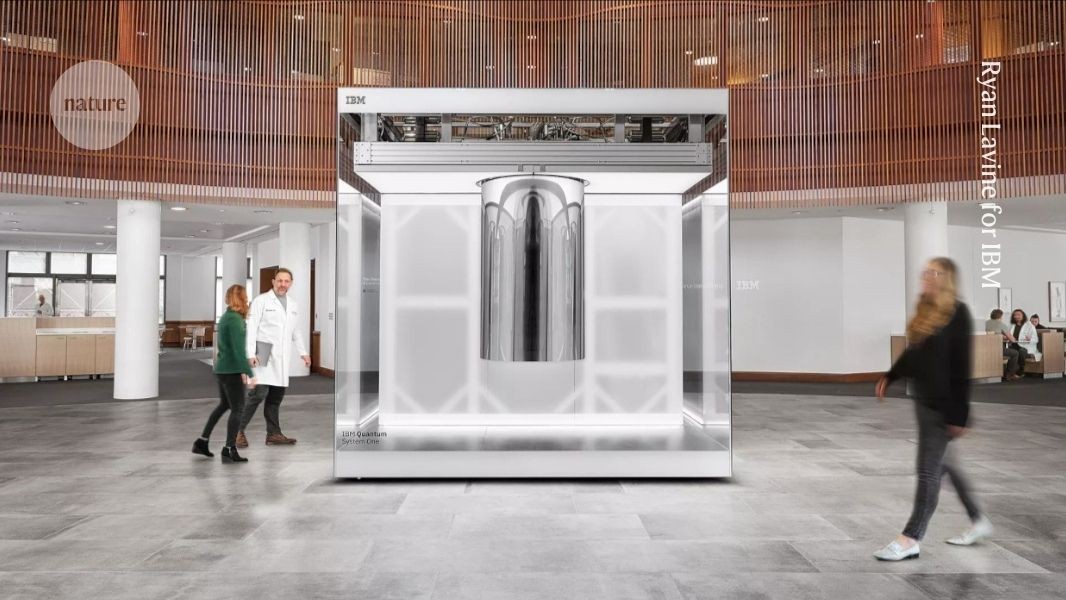

The winner of the $2 million Q4Bio prize used the IBM Quantum System One computer located at the Cleveland Clinic to run the simulations.Credit: Ryan Lavine for IBM
A team developing light-sensitive cancer drugs has won a US$2 million Quantum for Bio (Q4Bio) award to demonstrate the potential use of quantum computing in healthcare. But neither team was awarded the competition’s $5 million grand prize.
Prize organizers announced the winning team, made up of researchers from Helsinki-based quantum software firm Algorithmiq, tech giant IBM and Ohio’s Cleveland Clinic, on April 16.
The winning group is working to improve a type of cancer drug that can be activated using light once it reaches a tumor, making it less toxic to the rest of the body than conventional therapies. The team members simulated the way such a drug molecule interacts with light. Ultimately, they want to understand how changing the composition of the active molecule in the drug affects its properties, with the hope of applying it to many types of cancer.
Such complex simulations are too difficult for today’s quantum computers to perform. Instead, the team used a hybrid technique with computational chemistry methods for parts of the simulation and regular computers to process the inputs and outputs, says Sabrina Maniscalco, a quantum physicist and CEO and co-founder of Algorithmiq.
The most difficult parts of the simulation—reproducing how photons interact with electrons in a molecule—were done on a nascent quantum computer at the Cleveland Clinic, she says. “It’s exactly this problem that quantum computers are good at simulating,” she adds.
These types of simulation can still be performed with classical methods. However, the team won the $2 million prize for demonstrating that the same algorithms, when run on more capable quantum systems in the future, should be able to gather information about molecules that would be impossible using classical simulations, Maniscalco says. The algorithms can also be applied to other molecular problems, such as the design of new antimicrobial drugs, she adds.
Quantum computers are already tackling problems in physics and chemistrywith some researchers claiming to have performed calculations that would have been impossible on classical machines, an ability called the “quantum advantage”. But applications in biology remain elusive.
Although it was feasible for a team participating in the Q4Bio competition to achieve a quantum advantage, it was not achieved—nor was it the express goal of the competition.
Instead, research teams were challenged to develop algorithms and ways of working so that applications in biology would be ready once the hardware was in place, says Jonathan Hirst, a computational chemist at the University of Nottingham, UK. Hurst led one of the finalist projects, which aims to improve a drug to treat the genetic disease myotonic dystrophy.
The competition was launched in 2023 with the support of the US-based Wellcome Leap, a non-profit organization based in San Diego, California, which was created by the British charity Wellcome Trust.
When the competition began, “no one had taken the bold step of connecting” quantum computing and biology, says Shihan Sajid, Q4Bio’s program director. Dozens of entrants were whittled down to six over three stages, with finalists receiving up to $4.25 million in research funding during the 30-month challenge.